Yes, a Florida homeowners association can require you to get its approval before you change your exterior paint color, and it can fine you for painting without it, but only to the extent your community's own documents give it that power. Florida's HOA law, Chapter 720 of the Florida Statutes, does not pick colors for anyone. It says where the association's authority comes from and how a fine has to be handled.
That is why the answer you get from a neighbor, or from a site written for another state, often does not fit your house. Two subdivisions a mile apart in Broward can have completely different color rules, because the rules live in each community's declaration and architectural guidelines. The state law sits on top of those documents and sets the procedure.
A large share of our work is inside gated and HOA neighborhoods, and it is part of our exterior painting work. This guide quotes the statute sections that come up on those jobs and links to each one so you can read it yourself. We read the 2026 Florida Statutes on the Florida Legislature's site on October 11, 2026. This is general information, not legal advice: if you are already facing a fine or a dispute, read your own documents and talk to a Florida attorney.
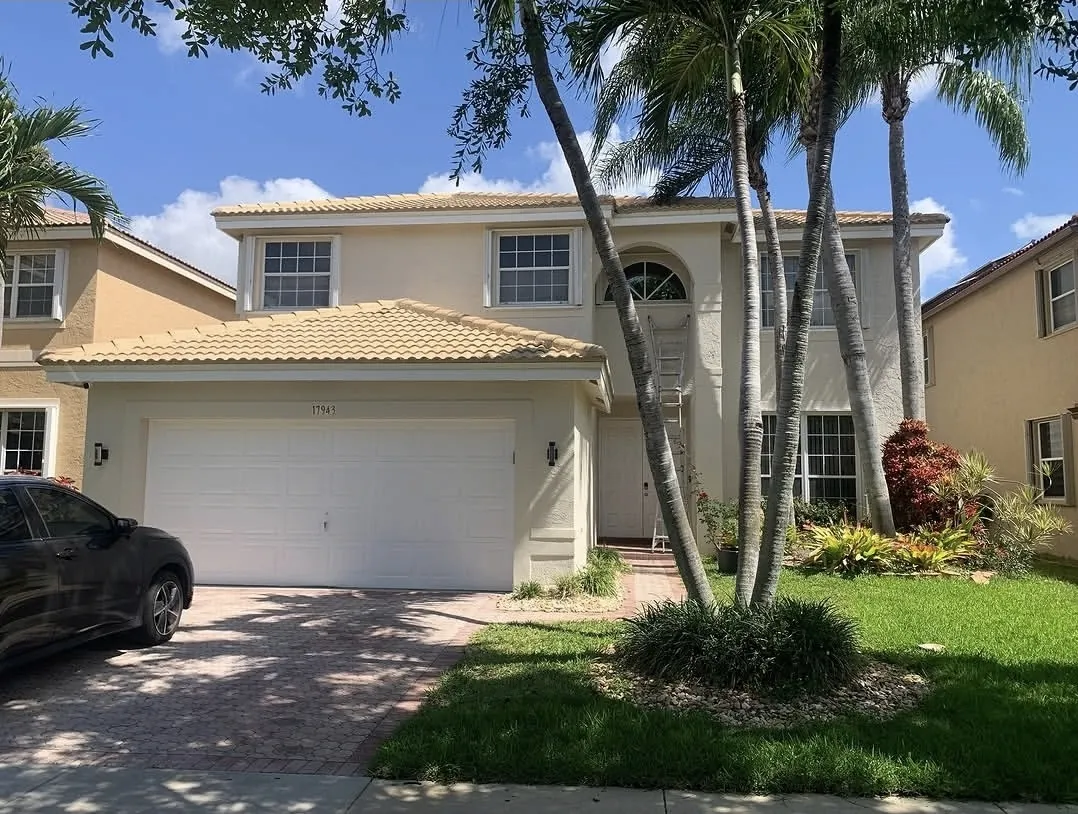
Where an HOA's say over your color comes from
The key section is 720.3035, "Architectural control covenants; parcel owner improvements; rights and privileges." It starts by limiting the association's authority to what its documents grant. The authority of an association or its architectural committee "to review and approve plans" for improvements on a parcel "shall be permitted only to the extent that the authority is specifically stated or reasonably inferred" as to "location, size, type, or appearance" "in the declaration of covenants or other published guidelines and standards."
In plain terms: if your declaration or the association's published architectural guidelines cover exterior colors, the association can require approval and hold you to them. If they do not, the statute does not supply that power on its own. The word "paint" does not appear anywhere in section 720.3035, and the word "color" appears only once, in the part about hurricane protection covered below.
The rules have to be applied to everyone
The same paragraph says the association or committee "must reasonably and equitably apply and enforce on all parcel owners" its architectural and construction improvement standards. If your request is held to a standard your neighbors were not, that sentence is the one to bring up with the board.
A denial has to say why
If the association or committee turns down a request, section 720.3035(4)(a) says it "must provide written notice to the parcel owner stating with specificity" both "the rule or covenant on which the association or committee relied" and "the specific aspect or part of the proposed improvement that does not conform to such rule or covenant." A one-line "denied" does not meet that. The same subsection says an owner's architectural rights and privileges under the declaration "may not be unreasonably infringed upon or impaired by the association," and paragraph (4)(b) lets an owner recover damages, costs and reasonable attorney fees when the association does so unreasonably, knowingly and willfully.
Shutters and other hurricane protection
Section 720.3035(6) treats hurricane protection differently from paint. The board or committee "must adopt hurricane protection specifications for each structure or other improvement on a parcel," and those specifications "may include the color and style of hurricane protection products." The association "may not deny an application for the installation, enhancement, or replacement of hurricane protection" that conforms to its adopted specifications, though it "may require a parcel owner to adhere to an existing unified building scheme regarding the external appearance" of the community. If you are painting shutters or a reinforced garage door, ask for those specifications too.
A city permit is not a prerequisite
The current version of 720.3035 also says the association "may not require a building permit to be issued by a governmental authority to a parcel owner as a prerequisite for review." For a repaint that rarely matters, because most nearby cities need no permit to paint a house at all. Our guide to paint permits in Hollywood and Broward quotes each city's rule.
Condos are under a different law
Everything here is about homeowners associations. Section 720.302(4) says "This chapter does not apply to any association that is subject to regulation under chapter 718, chapter 719, or chapter 721," which are the condominium, cooperative and timeshare chapters. If you live in a condo, your building's documents and Chapter 718 set the rules, and they are not covered in this guide.
Can the HOA make you repaint a faded house?
The statute does not say how often a house has to be painted or what counts as faded. That comes from your declaration, which typically includes a maintenance standard. What section 720.305 does say is that each member, and the member's tenants, guests and invitees, "are governed by, and must comply with" Chapter 720 and the community's governing documents, and it allows "Actions at law or in equity, or both," "to redress alleged failure or refusal to comply" with them. It also lets the association levy fines, under the procedure below.
So the real question is what your documents require. If they set a maintenance or appearance standard and your house no longer meets it, the association can enforce that standard. If you are not sure whether your house is due anyway, our guide to how often to repaint a Florida exterior covers how long paint actually lasts here, and what the stains on your stucco mean covers the marks that have to be dealt with before any new color goes on.
Painted without approval? Fines, the notice and the hearing
Section 720.305(2) starts: "An association may levy reasonable fines for violations of the declaration," the bylaws or reasonable rules of the association. The same subsection also lets an association suspend, "for a reasonable period of time," "the right of a member, or a member’s tenant, guest, or invitee, to use common areas and facilities." Then it sets limits.
How much the fine can be
- Per violation: "A fine may not exceed $100 per violation against any member," ending "unless otherwise provided in the governing documents."
- Continuing violations: a fine may be levied for each day of a continuing violation, but "the fine may not exceed $1,000 in the aggregate unless otherwise provided in the governing documents."
- Liens: "A fine of less than $1,000 may not become a lien against a parcel."
Both caps carry the phrase "unless otherwise provided in the governing documents," so your declaration can set different amounts. Read it before assuming the $100 and $1,000 figures apply to you.
The 14-day written notice
The statute says: "A fine or suspension levied by the board of administration may not be imposed unless the board first provides at least 14 days’ written notice of the parcel owner’s right to a hearing" to the owner at the mailing or e-mail address in the association's official records. Under paragraph (2)(b), the notice must include "a description of the alleged violation," "the specific action required to cure such violation, if applicable," and "the hearing date, location, and access information if held by telephone or other electronic means."
The hearing before a committee
"Such hearing must be held within 90 days after issuance of the notice before a committee of at least three members appointed by the board who are not officers, directors, or employees of the association, or the spouse, parent, child, brother, or sister of an officer, director, or employee."
Three more points from the same subsection:
- What the committee decides. "The role of the committee is limited to determining whether to confirm or reject the fine or suspension levied by the board."
- Majority vote. "If the committee, by majority vote, does not approve a proposed fine or suspension," it may not be imposed.
- Attending remotely. "The committee may hold the hearing by telephone or other electronic means," and "A parcel owner has the right to attend a hearing by telephone or other electronic means."
Fixing it first
This is the part most homeowners do not know: "If a violation has been cured before the hearing or in the manner specified in the written notice required in paragraph (b) or paragraph (d), a fine or suspension may not be imposed." If you painted without approval and the notice tells you what will cure it, doing that before the hearing takes the fine off the table.
After the hearing
"Within 7 days after the hearing, the committee shall provide written notice" of its findings, including any fines it approved or rejected and "how the parcel owner or any occupant, licensee, or invitee of the parcel owner may cure the violation, if applicable." If a fine is approved, the committee sets a payment date, "which date must be at least 30 days after delivery of the written notice."
Your HOA's power over your paint color comes from your declaration and published guidelines. A denial must name the rule and the problem in writing. A fine needs at least 14 days' written notice and a hearing before an independent committee within 90 days, it is capped at $100 per violation and $1,000 in total for a continuing violation unless your documents say otherwise, and it cannot be imposed if you cure the violation first.
The law changed recently. Read the current version
The history notes at the bottom of each statute page show recent amendments. Section 720.305 lists chapter 2024-221, Laws of Florida, among its amendments, and section 720.3035 lists chapters 2024-205 and 2024-221 and, most recently, chapter 2026-63. Advice written before those changes, including answers on legal Q&A sites, may describe an older version. The links in this guide go to the current statutes on the Florida Legislature's site.
How to get an exterior repaint approved
This is the part we can help with. We are painters, not lawyers, so we cannot tell you what your documents mean, but we can make sure your color request goes in complete.
- Ask the association for its rules first. Ask for the declaration and the architectural guidelines, the approved color palette if the community has one, and the request form. Ask how the committee wants the request submitted.
- Choose inside the palette if there is one. We help you choose within your community's approved palette.
- See the color on your own wall. A chip under store lights and the same color on stucco in Florida sun can look very different. We paint a real sample on your wall so you and the committee see what it will look like.
- Write out the exact color. Color name, code, brand and sheen, for the body, the trim and the doors. We write these out for your request form, and we have the product data sheets ready when your committee asks what is going on the wall.
- You submit it. The request comes from the homeowner, so you send it in with the specs we have written out for you.
- Get the approval in writing before work starts. Keep the approval letter or e-mail. We schedule the work around your approval, not before it.
If the request is denied, the written notice should tell you which rule it relied on and what part does not conform. That tells you what to change if you resubmit.
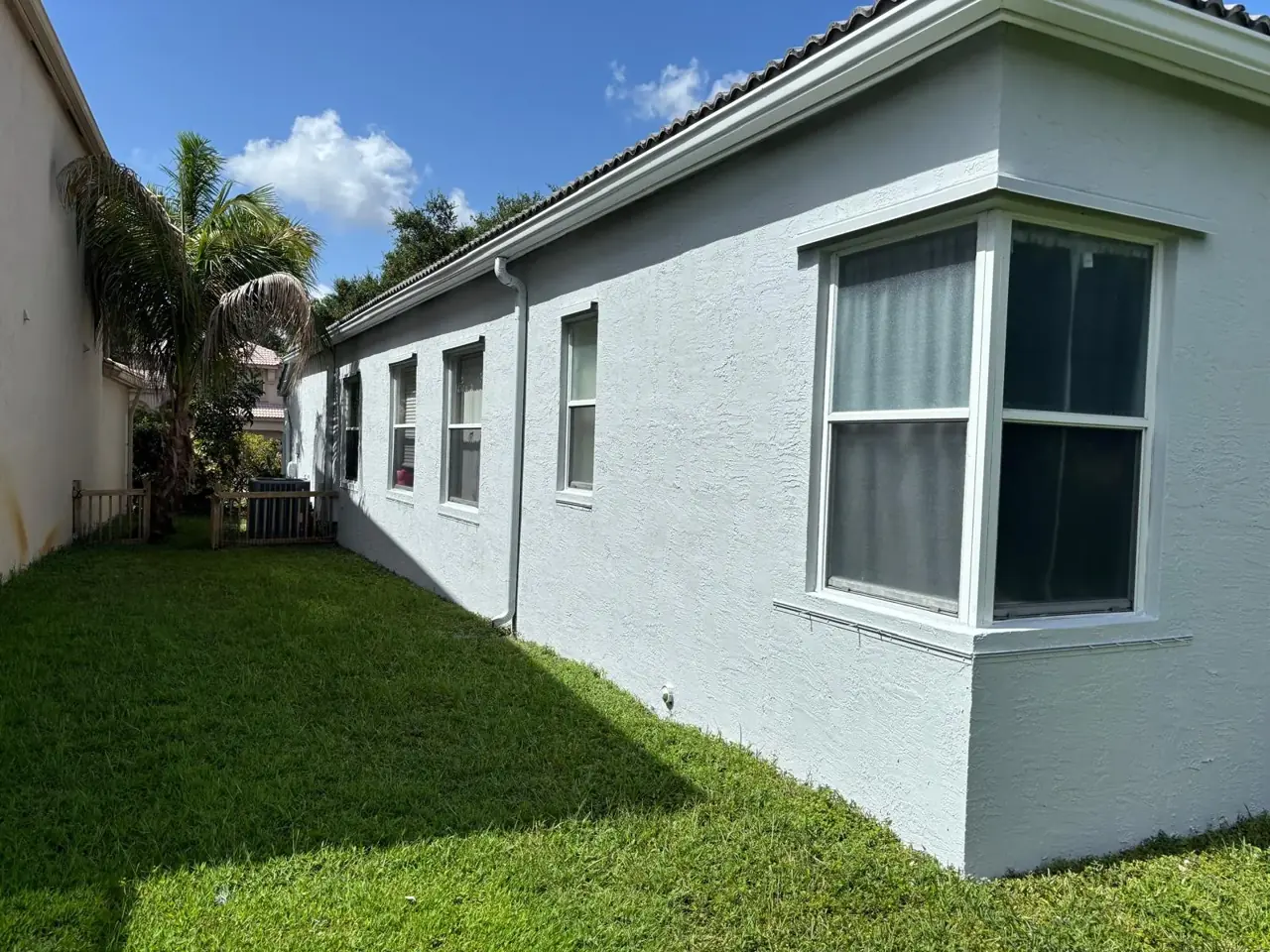
Pembroke Pines, Coral Springs and Parkland
These are HOA-heavy cities near us where the city itself does not require a permit to paint a house, so the association's approval is the one to plan around.
- Pembroke Pines. The city's planning and zoning FAQ says: "A building permit is not required, however, if you live in an area controlled by a Homeowners Association (HOA), you should contact the association or your property manager for any restrictions they may have."
- Coral Springs. Here there can be two sets of color rules: the association's and the city's own palette for single-family homes; the city says colors outside it could result in a citation from Code Compliance. Our permit guide quotes the city's palette rule.
- Parkland. The city's Building Division says no permit is required to paint, so in an HOA community the association's approval is the one that matters.
Planning an HOA repaint?
We have been painting in South Florida since 2004, owner-operated, in English and Spanish. Tell us your community and the colors your association allows, and we will give you a free written estimate for your exterior painting project, with the color specs written out for your request.
Get a Free Estimate 💬 WhatsApp Us