A homeowner in Hollywood called me last month with three quotes on her kitchen and no idea why they were so far apart. One was for painting. One was for refacing. One was for new cabinets. She thought she was comparing prices. She was comparing three different jobs that happen to end with a kitchen that looks new — and nobody had quoted her the fourth.
There are four things a company can sell you, and the difference between them is simply how much of your kitchen ends up in a dumpster. That is the whole thing. Once you see it that way, the quotes stop being confusing.
| The option | What is replaced | What stays | Can it change the door style? |
|---|---|---|---|
| Repaint | Nothing. New coating over what is there | Doors, drawer fronts, boxes, layout | No |
| Refinish | The old stain and clear coat, stripped back | Doors, drawer fronts, boxes, layout | No |
| Reface | Doors, drawer fronts, hardware, and a skin over the visible frames | The boxes and the layout | Yes |
| Replace | Everything | Only the room | Yes, and the layout too |
Swipe the table sideways to see all four columns.
1. Repainting: color and sheen, nothing else
Painting changes what your cabinets look like and nothing about what they are. The doors that were there are still there, in the same style, on the same boxes, in the same layout. What changes is color, sheen, and how clean the whole thing reads.
Done properly it is not a quick job, and the reason is the surface. A kitchen door carries years of cooking oil that has settled into the old finish, and paint will not bond through it. Sherwin-Williams' own cabinet guide starts in the same place we do: "Thoroughly wash all areas that you plan to paint with a good cleaner, degreaser or an emulsifying dish soap. Rinse with clean water and let it dry." Then scuff sanding, then the right primer for the surface underneath — they specify "an adhesion promoting primer" for laminate or previously painted wood, and a different one for bare wood.
It is the cheapest of the four by a wide margin, and for most kitchens it is the right answer. We wrote the longer version of when it is and is not in paint or replace.
2. Refinishing: the same doors, back to wood
Refinishing means stripping the old stain and clear coat off, sanding back to bare wood, and building a new stain and topcoat on the original boards. The grain you end up looking at is the grain you already owned.
Two things decide whether it is even possible.
- The doors have to be real wood. Not veneer over particleboard, not laminate, not a foil wrap. Strip a thin veneer and you go through it.
- You have to want wood at the end. Refinishing cannot give you white cabinets. If the goal is painted white shaker, refinishing is the wrong door.
It is worth knowing that the trade uses "refinishing" loosely. Two of the three big paint manufacturers file their cabinet painting guidance under refinishing, so when a company quotes you for cabinet refinishing, ask plainly whether they mean stripping back to wood or painting over. They are different jobs with different prices.
3. Refacing: new doors on the cabinets you already have
This is the one most people have never had explained, and it is usually the one missing from their comparison.
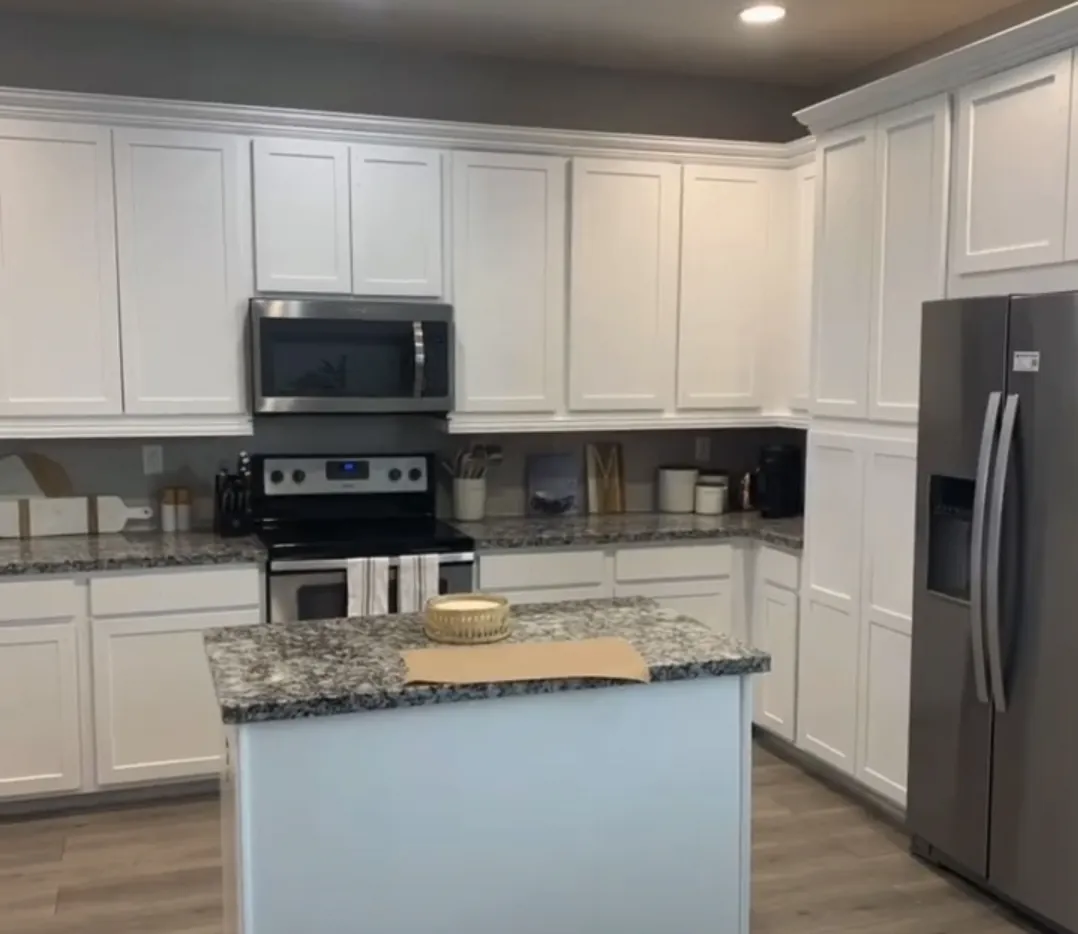
Refacing keeps your cabinet boxes and your layout and replaces everything you touch. Refacing suppliers describe it as "replacing only the doors, drawer fronts, and hardware," with the existing structure left in place. In practice a refacing job also puts a matching veneer or laminate skin over the visible face frames and end panels, so the parts of the box you can still see match the new doors instead of announcing the old kitchen underneath.
What that buys you is the thing painting cannot do: a different door. Raised panel becomes shaker. Oak arches become flat slab. You can go from wood to painted, or painted to wood, because the doors are new.
It is also quicker than replacing. The suppliers who sell refacing kits put the installation at a day or two on site, and that tracks with what the work involves. A replacement is a longer project by its nature, because the new boxes have to be measured, built and delivered before anyone starts.
What it does not buy you is a different kitchen. The boxes stay where they are, at the size they are. If the problem with your kitchen is that the pantry is too small or the corner cabinet is unusable, refacing will not touch it. You will have paid for a beautiful version of the same frustration.
4. Replacing: the only one that moves anything
New cabinets are the answer when the boxes are done, or when the layout is the actual problem. It is the most disruptive and the most expensive, and it is the only option on this page that can move a wall of storage somewhere more useful.
We are painters, so take this in the spirit it is meant: on perhaps one kitchen in five that we look at, we say the cabinets are not worth coating and the homeowner should talk to a cabinet company instead. A painted rotten box is a rotten box that is now white.
Look at the boxes, not the doors. If the structure is sound and the layout works, three of the four are worth considering and the choice is about the door. If the boxes are failing or the layout is wrong, only replacement actually solves it, and the other three are money spent on the wrong problem.
Why the box is the thing to look at
The cabinet industry has a performance standard, and reading it changes how you value what is already in your kitchen. ANSI/KCMA A161.1, published by the Kitchen Cabinet Manufacturers Association, is what "certified cabinet" means. To carry it, a cabinet has to survive a set of tests that sound absurd until you see what they are standing in for. They compress years of ordinary kitchen use into a few days of deliberate abuse.
- Doors are cycled open and closed 25,000 times, at twenty cycles a minute, with the catch engaging and disengaging every time.
- Drawers get the same 25,000 cycles, loaded, opened two-thirds of the way each time.
- Every shelf and cabinet bottom is loaded to 15 pounds per square foot for seven straight days and may not sag more than a sixteenth of an inch per foot of span, or a quarter of an inch between any two supports, whichever is smaller.
- The finish is held at 120°F and 70 percent relative humidity for 24 hours, then cycled five times between that hotbox and a freezer at roughly 6°F below zero.
Read that heat-and-humidity test again, because it is a fair description of a South Florida kitchen in August with the air conditioning struggling. It is run on factory finishes rather than on field-applied paint, so it settles nothing about painting. What it tells you is what this climate asks of a cabinet. If your boxes have done fifteen years of it and the shelves are still flat and the doors still hang square, you own something worth keeping. That is the argument for painting or refacing rather than replacing, and it is a better argument than price.
It is also the argument against them. Particleboard that has swollen under a leaking sink does not un-swell. A face frame that has pulled loose does not tighten up because there is a new door on it.
What your doors are made of decides what is possible
Before anyone quotes anything, open a door and look at the edge and the back.
- Solid wood or wood veneer. Every option is open. Paint, refinish, reface, replace.
- Laminate or melamine. Paintable, with the right preparation. Behr answers this one directly: laminate and melamine cabinets "can be painted if the surface is cleaned, scuff sanded, and primed first." Refinishing is out, because there is no wood to go back to.
- Thermofoil. This is a vinyl film heat-wrapped over an MDF core, and its condition decides everything. Film that is still fully bonded can be coated with a bonding primer. Where the film has lifted or peeled — usually beside the oven, the range or the coffee maker, wherever the heat lives — there is nothing sound left to paint onto, and coating a lifting edge gets you a painted lifting edge. Those doors need replacing, which means refacing or new cabinets.
A door that is heavy for its size and warm to the touch is usually wood. One that is very light for its size, with a seamless wrapped edge and a flat paper-looking back, is usually thermofoil. If you cannot tell, that is fine — it is the first thing we check on a walkthrough.
The 30-day fact nobody puts in a quote
This is the part that decides whether a painted kitchen still looks good in year three, and almost nobody explains it before the work starts.
Paint dries in hours and cures over weeks. Those are different things. Benjamin Moore's technical data sheet for its door, trim and cabinet enamel gives dry to touch at two hours and recoat at four hours, measured at 77°F and 50 percent relative humidity — and then this: "Depending on drying conditions, allow up to 30 days to reach optimum hardness and final sheen."
Thirty days. On the highest-touch surface in the house. Benjamin Moore's own contractor guidance says it plainly: "Cabinets are high-touch surfaces and require the complete cure time per product instructions," and recommends contractors write it into the contract. Sherwin-Williams is more conservative than most people expect about even the first step, asking for "at least 24 hours of dry time — the longer the better" before doors and hardware go back on.
What this means for you is practical, not theoretical. In the first few weeks the finish is still hardening, so doors get closed rather than slammed, nothing gets stacked against a fresh face, felt pads go on before the doors meet the frames, and cleaning is a damp cloth rather than a spray cleaner. The first month is when marks stick, so a kitchen that gets a gentle month keeps its finish looking sprayed for a long time afterward.
There is a Florida wrinkle too. Those dry times were measured at 50 percent relative humidity, which a South Florida kitchen rarely is, and the same Benjamin Moore data sheet says plainly that "high humidity and cool temperatures will result in longer dry, recoat and service times." Plan on longer than the label rather than shorter. We would rather tell you that up front than have you call months later wondering why the door edges are scuffing.
How to compare four quotes honestly
We do not publish prices, because a kitchen quote that means anything comes from standing in the kitchen. But you can compare quotes properly without knowing our numbers, and it comes down to four questions.
- What exactly is being replaced? Get it in writing. "Refinishing" from one company and "refinishing" from another can mean stripping to wood or spraying over. Ask which.
- Do the doors leave the house? Doors sprayed flat, off the hinges, in a controlled space come back even on both faces and all four edges. Doors painted hanging in place do not, and that difference shows most on the top edge nobody thinks to look at.
- What is the primer, and why that one? The honest answer is specific and depends on what your doors are made of. A vague answer usually means one primer for every job.
- What happens if it fails? Ask what is warranted and for how long, and get that written down too. We put a written workmanship warranty on every job, so it is a fair question to ask all four companies.
Then compare like with like. Painting against refacing is not really a price comparison, it is a decision about whether you want your doors changed. Once you have decided that, the prices you are looking at finally mean something.
What we actually do on a walkthrough
It takes about twenty minutes and it is the same five checks every time.
- Open a door, look at the edge, name the material out loud.
- Check under the sink, because that is where water damage starts and where it hides.
- Push on a shelf and a face frame. Sound structure, or not.
- Ask what you want the kitchen to look like, not what you want done to it. If the answer involves a different door style, painting is off the table and we say so.
- Ask when you need the kitchen back, because that decides what is realistic once curing is in the picture.
Sometimes the answer is that we are the wrong trade for the job, and we would rather say that in the kitchen than after a deposit. If painting is the right call, that is what we do, doors off and sprayed. If the finish you are after is a mirror rather than a satin, the high gloss piece covers what that really takes.
Not sure which of the four you need?
Send a photo of one open door on WhatsApp. We can usually tell you what it is made of and which options are actually available to you before anyone comes out. Free written estimates across Hollywood, Pembroke Pines, Miramar, Davie, Fort Lauderdale and the rest of Broward.
Get a Free Estimate 💬 WhatsApp Us