The best time of year to paint a house exterior in South Florida is the dry season, roughly November through April. Exterior paint needs three things from the weather: a dry wall, temperatures inside the range on the label, and enough dry hours afterward for the paint to set before rain or dew reaches it. From November to April, all three are easy to get. From June to September, all three take planning.
Every number in this guide comes from its source. The rain and temperature figures are NOAA's official 1991–2020 climate normals for Fort Lauderdale/Hollywood International Airport, the station between Fort Lauderdale and Hollywood. The season dates come from the National Weather Service office in Miami, and the limits on heat, rain and dew are quoted from the paint makers' own labels and data sheets. We checked every number on those pages on October 18, 2026.
South Florida has two seasons, and the difference is rain
The National Weather Service office in Miami studied the records from Miami International Airport from 1956 through 1997 to pin down when the summer season in South Florida starts and ends. The median start date was May 21 and the median end was October 17. In individual years it started as early as April 16 and as late as June 3, and ended as early as September 24 and as late as November 1. On average, 69% of the year's rain fell in that summer season.
The same study describes the difference in plain terms. During the summer, "the dew-point temperature remains in the lower to middle 70s," and showers and thunderstorms are "almost a daily occurrence." The other half of the year is different: "The winter season has cooler temperatures, lower humidities and less frequent precipitation."
The year month by month
These are NOAA's 1991–2020 monthly climate normals for Fort Lauderdale/Hollywood International Airport. A normal is a 30-year average, so any single month can run wetter or drier. "Rainy days" here means days with at least a tenth of an inch of rain.
| Month | Average rain (inches) | Rainy days (0.10″ or more) | Average high (°F) | Average low (°F) |
|---|---|---|---|---|
| January | 2.90 | 3.8 | 75.6 | 60.9 |
| February | 2.38 | 3.4 | 77.4 | 63.3 |
| March | 2.38 | 3.4 | 79.7 | 65.6 |
| April | 3.02 | 4.1 | 82.9 | 69.9 |
| May | 5.56 | 7.4 | 85.8 | 73.5 |
| June | 9.55 | 10.5 | 88.4 | 76.6 |
| July | 5.41 | 10.6 | 90.0 | 77.6 |
| August | 7.89 | 11.2 | 90.0 | 77.9 |
| September | 8.02 | 10.8 | 88.3 | 77.1 |
| October | 7.37 | 7.9 | 85.4 | 74.4 |
| November | 3.69 | 4.8 | 80.8 | 68.3 |
| December | 2.78 | 4.2 | 77.7 | 64.7 |
Swipe the table sideways to see all five columns.
What the table says for a paint job:
- November through April is the window. Rain runs 2.38 to 3.69 inches a month, with about 3 to 5 rainy days a month, and average highs stay between 75.6°F and 82.9°F.
- June through September is the hardest stretch. Each of those months averages more than 10 rainy days, with highs of 88.3°F to 90.0°F. June is the wettest month, at 9.55 inches.
- July is drier than it feels, but not dry. It averages 5.41 inches, less than June, August or September, yet it still has about 10.6 rainy days. Less rain in total does not mean fewer rainy days.
- May and October are the in-between months. May averages 7.4 rainy days and October 7.9. The rainy season's median end date is October 17, so the first half of October usually still behaves like summer.
What the paint labels say about heat, rain and dew
Every exterior paint comes with limits printed on the label and in its data sheet. Here is what four major makers say, quoted from their own pages. The specific product on your house may differ, so the label on the can is the one to follow.
Temperature
Behr's instructions for its Ultra exterior paint say to apply it "when air and surface temperatures are between 35°–90°F" and will stay in that range "for at least 4 hours after applying." Behr's elastomeric masonry, stucco and brick paint has a narrower range: 50–90°F, air and surface. Benjamin Moore's Aura exterior low lustre data sheet lists a maximum surface temperature at application of 100°F.
Compare that with the table. The normal high at the airport is 90.0°F in July and in August, the very top of Behr's range, and that is the air in the shade. A wall in full sun can run hotter than the air around it, and the label's limit applies to the surface too.
Direct sun
Sherwin-Williams answers this one in its exterior application FAQ: "It's best to avoid painting in direct sunlight, especially during the hot summer months." It explains that the sun's heat makes the paint dry too quickly, which can cause brush marks, lap marks and poor adhesion, and its advice is to move around the house to stay out of the sun.
Rain
Behr's Ultra instructions say: "Do not paint when rain or heavy condensation is expected." For its elastomeric, Behr says not to use it "if rain or heavy dew is expected within 24 hours." After a storm, Sherwin-Williams' answer is to wait "a MINIMUM of one day after a heavy rain," and it adds that "the surface must be dry before painting." Benjamin Moore notes that high humidity lengthens dry, recoat and service times.
Dew
Dew is the problem people forget. PPG's data sheet for its Permanizer exterior satin says to apply it only when the air, surface and paint are "at least 5°F (3°C) above the dew point," and: "Do not apply late in the day when dew and condensation are likely to form or if rain or snow is expected." Sherwin-Williams says the temperature should ideally stay above the dew point "for at least 48 hours after application," and warns that dew "forms on almost everything as soon as the sun goes down."
Put that next to the weather service's numbers. In summer, dew points sit in the lower to middle 70s, and the normal overnight lows from June through September are 76.6°F to 77.9°F. That can leave less than PPG's 5°F margin in the early morning, before the sun has dried the wall. In the dry season, lower humidity and cooler nights make that margin easier to keep.
Plan an exterior repaint for November through April if you can. From June through September, expect rain on more than 10 days a month, highs at the top of the label range and dew most mornings. The paint can still go on in summer, but only in the dry, shaded hours between the morning dew and the afternoon storms, and only within the limits on the label.
Hurricane season sits on top of the rainy season
The National Hurricane Center says the Atlantic hurricane season "runs from June 1 to November 30," and that its peak is September 10, "with most activity occurring between mid-August and mid-October." That is the same stretch as the wettest part of the rainy season. If a tropical storm is in the forecast, wait: fresh paint needs dry hours after it goes on, and a storm brings neither dry hours nor a clean wall.
Painting in summer anyway
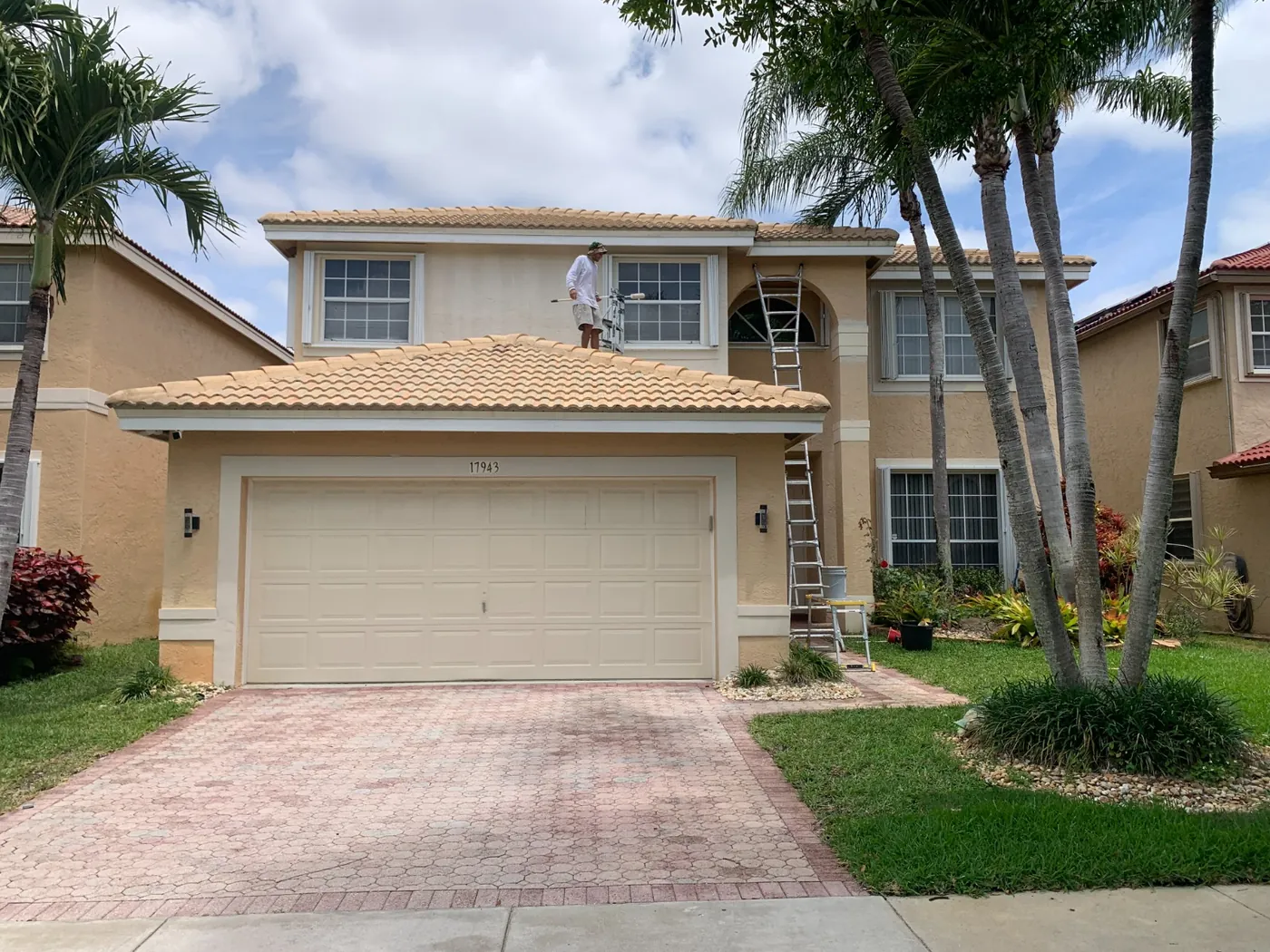
Not every project can wait for winter. A house going on the market, storm damage, or an HOA deadline will not move for the weather. We paint year-round, and in summer the work runs on the forecast instead of the calendar. If you are painting in summer, or hiring someone who is, these are the habits the sources above point to:
- Start once the wall is dry, not at sunrise. A wall that is wet with dew is still wet. On the coast, the weather service notes that with easterly winds, showers tend to come "late night and morning" over coastal areas, so near the beach a morning start is not automatically a dry one.
- Follow the shade around the house. Paint the west side in the morning and the east side in the afternoon, so the paint never goes onto a wall the sun is baking.
- Stop early. In light winds, the weather service says afternoon thunderstorms "develop over southeast Florida and affect most areas." Paint that went on at 3 PM has little time before a 4 PM storm, and then the evening dew.
- Read the rain limit on the label. Products differ; Behr's elastomeric, for one, should not go on if rain or heavy dew is expected within 24 hours.
- Give the wall time after a downpour. At least a day after heavy rain, and longer if the stucco still looks dark or feels damp.
Before you pick a date
Weather is only one part of the schedule. If you live in a community with an HOA, the association's approval usually has to come first; our guide on whether a Florida HOA can make you repaint quotes the law on approvals. If you are in Hollywood, a single-family home does not need a city permit to repaint; our paint permit guide covers Hollywood and nearby Broward cities. And if you are not sure the house needs paint yet, how often to repaint a Florida exterior lists the signs to look for. Stains that keep coming back are covered in what stucco stains are telling you.
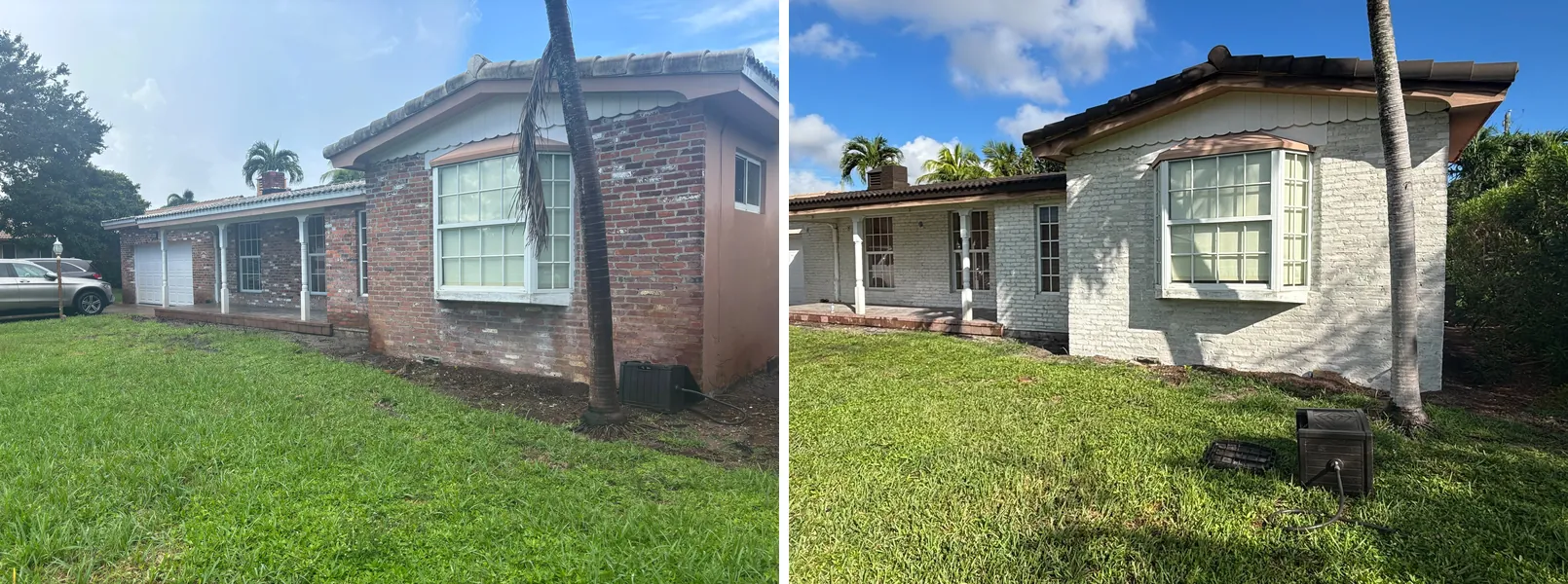
Paint is not the only exterior finish. On this brick home in Hollywood, we applied limewash instead of paint; our limewash page explains how the finish works.
Planning a dry-season repaint?
We have been painting in South Florida since 2004, owner-operated, in English and Spanish. Tell us about your house and when you would like the work done, and we will give you a free written estimate for your exterior painting project.
Get a Free Estimate 💬 WhatsApp Us