Limewash and regular exterior paint look like two versions of the same thing. They are not. Paint forms a film on top of the wall. Limewash is a thin mineral coat that soaks into bare masonry and lets the wall breathe. Which one belongs on your house depends on what the wall is made of, the look you want and how much upkeep you are willing to do. It doesn't come down to which one is better in general.
Two beliefs about limewash come up a lot: that it's a European thing, and that it prevents mold. This guide checks both against the sources, along with the practical differences on a South Florida house. Every fact here is linked to the page it came from, and we checked each one on October 25, 2026.
Limewash suits bare brick and stone, a soft, weathered look, and an owner who doesn't mind renewing it every few years. Regular exterior paint suits stucco that is already painted, solid colors and longer stretches between jobs. Limewash resists mold only while it is fresh; on any finish, keeping the wall dry is what keeps mold away.
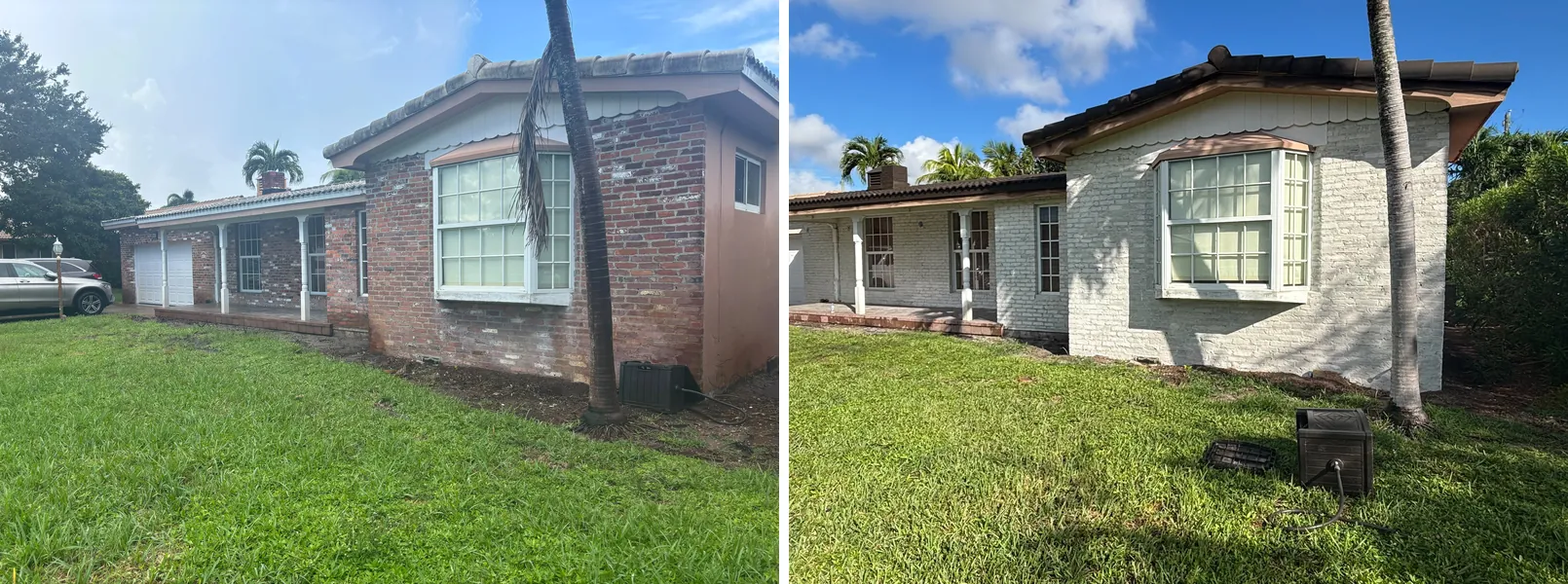
The difference between limewash and paint
Limewash is about as simple as a finish gets. The Society for the Protection of Ancient Buildings in the UK describes it as a simple, flat-finish paint made from lime and water, colored with mineral pigments. Lime putty is diluted to the consistency of milk and brushed on in thin coats.
Regular exterior house paint works differently. It dries into a continuous film that sits on the surface, covers evenly and sheds water. That's why it can make a wall any solid color you choose and look the same from corner to corner. Limewash is translucent, so the wall underneath shows through, and the color varies from spot to spot. SPAB calls that variation one of its advantages, noting that the color varies attractively, especially after weathering.
Is limewash a European thing?
Not really. Europe has a long and well-documented tradition, and SPAB notes that limewash was used inside and outside buildings in Britain for centuries. But lime as a building finish is far older than Europe's version of it. A 1988 study in the Journal of Field Archaeology traces lime plaster back to about 12,000 BC in the Near East.
It was also common on this side of the Atlantic. The National Park Service writes that in the American South, plantation landscapes were limewashed or "whitewashed," using lime from local deposits during the colonial period. Its preservation course adds that limewash came into widespread use during the nineteenth century, and that ready-made paint only began to take over after the Civil War.
So limewash isn't European. The look that's popular now, soft and chalky with old-world texture, is mostly associated with Mediterranean and European houses, and that's where the reputation comes from.
Does limewash prevent mold?
This is the claim that gets oversold most, so here is what the sources actually say.
Fresh limewash does resist mold. Lime is strongly alkaline when it goes on. The National Park Service describes limewash as antiseptic and antifungal, and SPAB says its alkalinity helps keep walls sterile.
That effect fades. Romabio, a limewash maker, takes this on directly. Asked whether limewash acts as a fungicide because of its high pH, the company answers "Incorrect." In its myth-busting article, it explains that limewash is mold-resistant initially, upon application, but once the pH is neutralized over time, the finish loses its ability to ward off microorganisms.
Lime walls can still grow mold when they stay damp. A 2024 field study of lime-plastered houses in India, published in UCL Open Environment, found walls at risk of mold when indoor humidity stayed above 60% for more than four weeks. It also found mold where nonporous coatings had been put over the plaster. The same study found no mold in spaces that were well maintained, ventilated and sunlit. That was lime plaster in a drier climate than ours, not limewash in South Florida, but the lesson carries over.
Moisture is what matters. The EPA's guide to mold is blunt about this: the key to mold control is moisture control. The same guide says not to paint over moldy surfaces. That applies to limewash too: existing mold has to be cleaned off and the source of the water fixed before any finish goes on.
Partly. Fresh limewash resists mold, and because it breathes, a wall can dry out instead of holding moisture behind a film. But it doesn't kill mold that is already there, and it won't keep mold away on a wall that stays wet from a leak, a gutter or the sprinklers.
Breathability, and is limewash waterproof?
Breathability is limewash's real advantage. SPAB calls it considerably more "breathable" than most modern paints, and the National Park Service notes that its vapor permeability allows for greater water transfer than most modern finishes. Moisture that gets into a masonry wall can leave through the limewash instead of being trapped behind it.
That also means limewash is not waterproof. SPAB notes that a limewashed wall temporarily darkens after rain, and that limewash can often be removed with water unless water-shedding additives are mixed in. If you want a coating that sheds every storm, that's a job for exterior paint. For water coming through the walls themselves, see our waterproofing service.
Which one fits your house?
Bare brick or stone
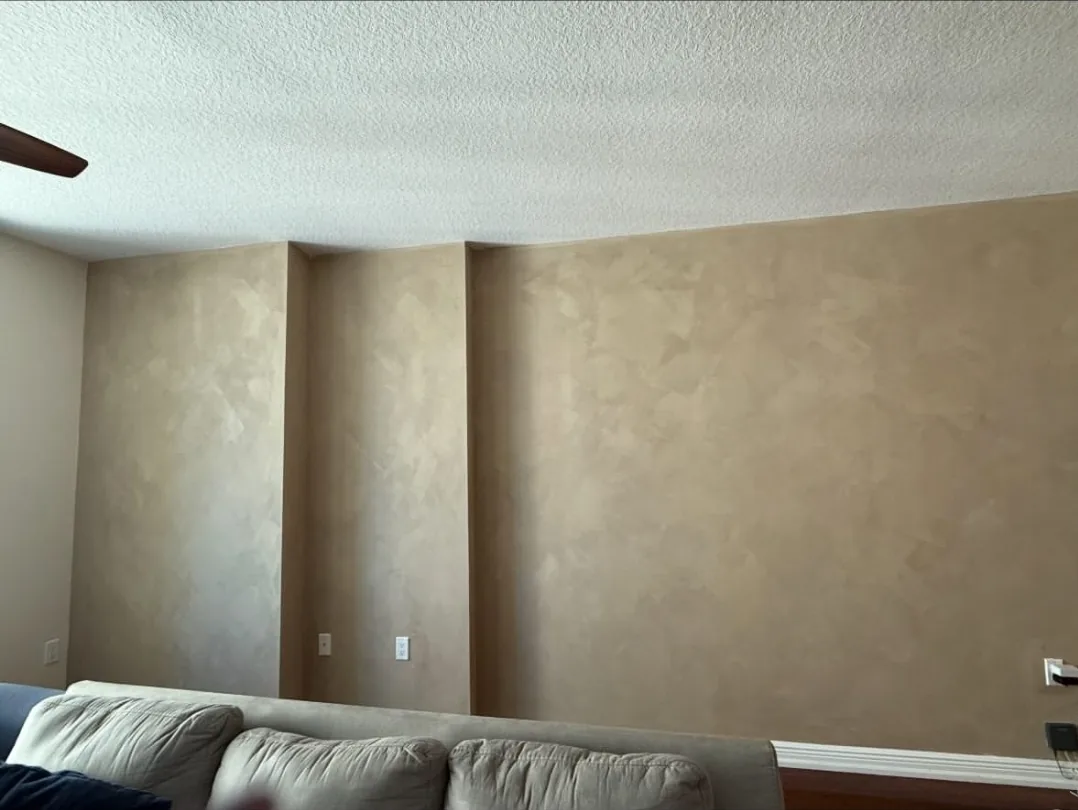
This is where limewash is at its best. Unpainted brick and stone are porous enough for limewash to soak in, and the result is the soft, weathered look in the photo above.
Stucco that is already painted
This describes most houses in South Florida, and it's where you have to be careful. Limewash can't soak into a paint film. Romabio's own guidance for a surface that isn't porous enough is to use its primer and a mineral masonry paint instead of limewash. Where makers do allow limewash over stucco, they require a primer or undercoat first. Our guide covers limewash on brick and stucco outside step by step.
A solid color, or a house you don't want to touch for years
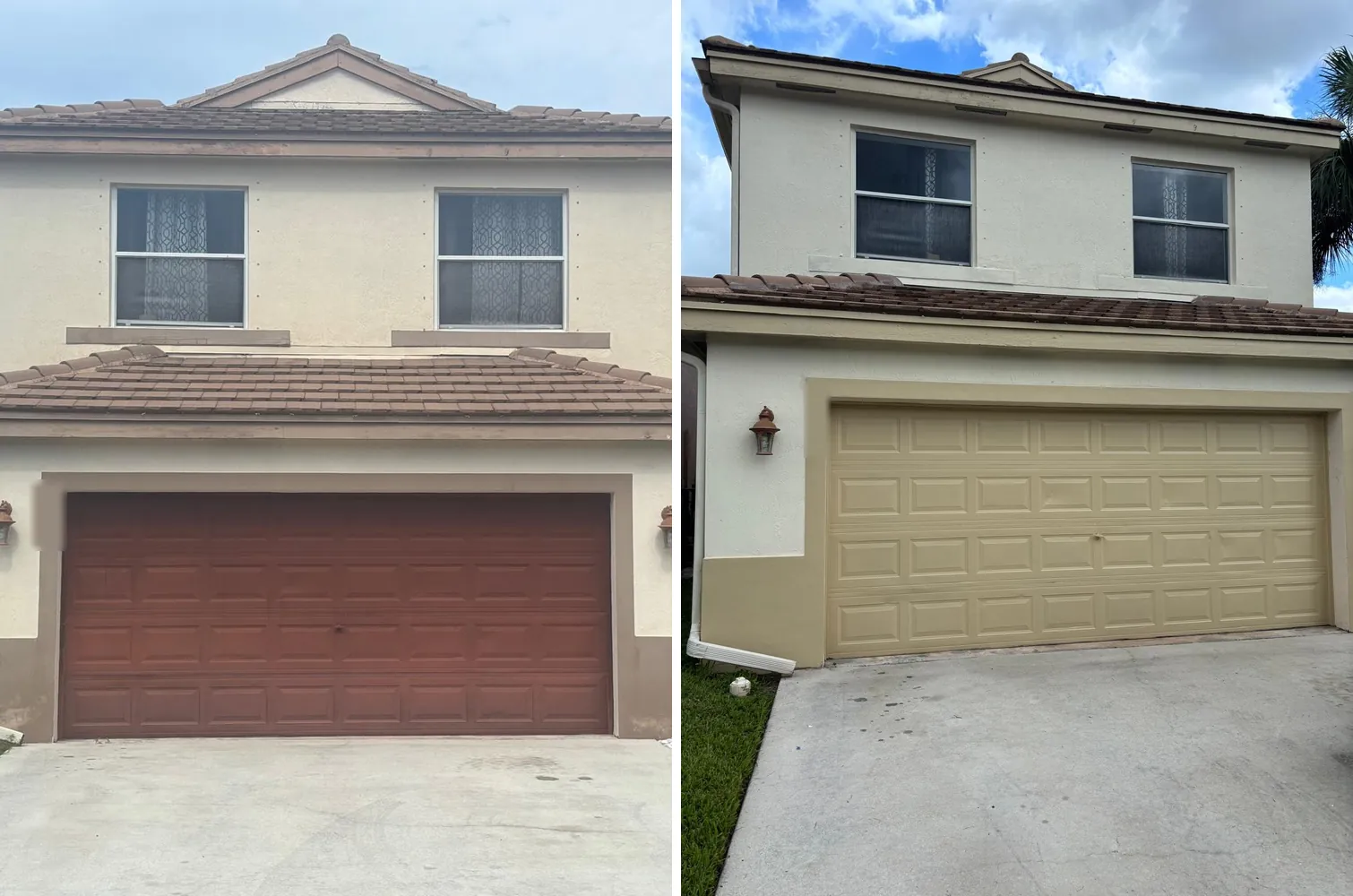
Regular exterior paint is the better choice here. It covers evenly in any color, sheds rain and holds its look longer between jobs. Our exterior painting service covers stucco, trim and doors.
Upkeep over the years
Limewash asks for more maintenance. SPAB says it typically requires renewing every five years, and historically it was redone even more often: the National Park Service notes that annual reapplication was necessary on exposed surfaces. The trade-off is how it ages. Limewash wears down gradually and can be refreshed with another coat, while a paint film that fails tends to peel and needs scraping first. If you're weighing a paint job instead, our guide to how often to repaint a Florida exterior covers that side.
Limewash vs. paint, side by side
| Limewash | Regular exterior paint | |
|---|---|---|
| What it is | Lime, water and mineral pigment | A film-forming paint |
| Look | Soft, chalky, varies across the wall | Even, solid color |
| Best surface | Bare brick and stone | Painted stucco, block, trim |
| Mold | Resists it while fresh; the effect fades | Depends on the product |
| Breathability | High | Lower than limewash |
| Rain | Darkens when wet; not waterproof | Sheds water |
| Upkeep | Renewed every few years | Longer between jobs |
Not sure which one your house needs?
We have been painting in South Florida since 2004, owner-operated, in English and Spanish. We'll look at your walls, tell you honestly whether limewash or paint is the better fit, and give you a free written estimate. See our limewash painting service.
Get a Free Estimate 💬 WhatsApp Us